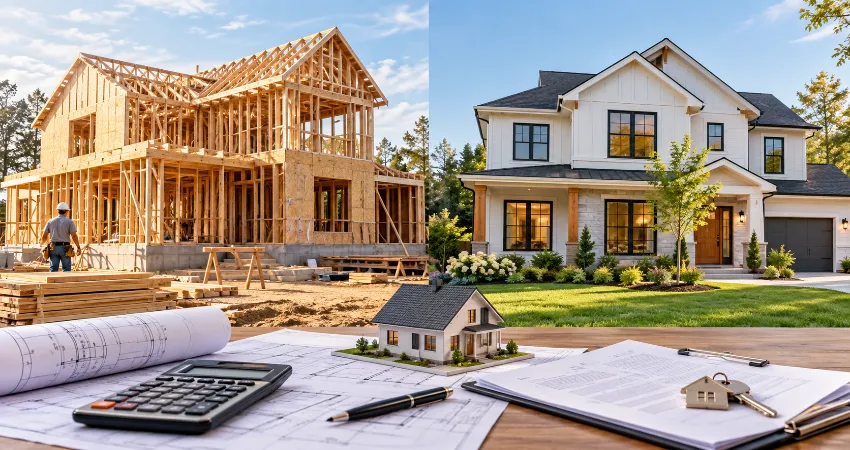
Building a new home creates a financing challenge that does not exist when buying a completed house. Before you can move in, money may be needed for the land, foundation, framing, roofing, electrical work, plumbing, finishes, permits, and contractor payments. A traditional mortgage is mainly designed around a completed property, while a construction loan is designed around a home that is still being built.
This makes the construction loan vs. mortgage decision less about choosing one financial product over another and more about matching financing to the stage of the property. During construction, lenders must manage risks related to unfinished work, changing costs, inspections, and contractor performance. Once the home is completed, financing becomes more similar to a standard residential mortgage.
Understanding how each loan works can help you estimate cash requirements, avoid unexpected financing gaps, and choose a structure that fits both your construction schedule and long-term housing budget.
What Is a Construction Loan?
A construction loan is usually short-term financing used to pay expenses associated with building a home. Instead of providing the entire loan amount to the borrower at closing, the lender generally releases funds gradually as construction progresses. These releases are commonly called draws. The Consumer Financial Protection Bureau explains that construction loans typically provide funds through a series of advances and may carry higher interest rates than longer-term mortgages.
For example, a builder might receive one draw after the foundation is completed, another after framing, and additional draws as major construction stages are verified. The lender may require inspections before releasing additional funds. This system helps ensure that loan proceeds are being used for the property being financed.
What Is a Traditional Mortgage?
A traditional mortgage is long-term financing generally used to purchase or refinance a completed home. The borrower receives financing based on factors such as income, credit profile, debts, property value, down payment, and the lender’s underwriting requirements. Payments are usually structured over many years and commonly include principal and interest, along with applicable property taxes and insurance costs.
A standard mortgage is usually easier to understand from a cash-flow perspective because the property already exists and the lender does not need to supervise a construction budget. When building from the ground up, however, a normal purchase mortgage generally cannot perform the same job as construction financing because contractors need money before the completed house exists.
Construction Loan Vs. Mortgage: The Main Differences
| Feature | Construction Loan | Traditional Mortgage |
|---|---|---|
| Main Purpose | Finance the construction of a home | Finance a completed property |
| Loan Period | Usually short-term | Long-term |
| Fund Distribution | Released through construction draws | Generally funded at closing |
| Property Condition | Home may not yet exist or may be incomplete | Home is normally completed |
| Lender Oversight | Usually includes inspections and draw approvals | Normally does not involve construction monitoring |
| Long-Term Financing | May require conversion or refinancing | Already structured as permanent financing |
Why Construction Financing Usually Requires More Documentation?
Financing a proposed home requires the lender to evaluate more than the borrower’s personal finances. The lender may also review building plans, specifications, construction contracts, projected costs, permits, contractor information, timelines, and the expected value of the completed property.
🔥 এই লেখাগুলো অবশ্যই পড়ুন

Documentation continues to matter during construction. Freddie Mac guidance, for example, notes that mortgage files for certain construction conversion transactions must contain sufficient documentation supporting actual construction costs, which may include contracts, plans, invoices, receipts, and lien waivers.
This additional review is one reason borrowers should organize construction documents before submitting a financing application rather than waiting until the lender requests them one by one.
How Construction Loan Draws Affect Your Budget?
The draw system is one of the most important differences to understand. A lender may approve a total construction budget, but that does not mean the entire amount becomes immediately available. Contractors often submit draw requests after completing agreed milestones, and an inspection may occur before the lender authorizes payment.
Homeowners should therefore coordinate the contractor’s payment schedule with the lender’s draw procedure before construction begins. A contractor expecting immediate payment could create a cash-flow problem if the lender requires several days for inspection and approval.
A practical construction budget should also contain room for unexpected costs. Material prices can change, site conditions can reveal additional work, and homeowners sometimes request upgrades during construction. Financing the maximum expected project cost without maintaining accessible reserves can make these changes difficult to absorb.
Construction-to-Permanent Loans Explained
A construction-to-permanent loan combines the construction phase and the eventual long-term mortgage into one financing structure. With a single-closing structure, the borrower can close on construction financing and permanent financing together. After eligible construction requirements are completed, the loan converts into permanent mortgage financing rather than requiring an entirely separate purchase mortgage.
Fannie Mae’s current guidance describes single-closing construction-to-permanent transactions in which the lender manages construction disbursements and the financing automatically converts to a long-term mortgage after completion. Its eligible framework also allows permanent loan terms of up to 30 years after conversion, excluding the construction period.
The major practical advantage is simplicity. A borrower may reduce the need for a second full closing. However, terms vary significantly among lenders, so borrowers should determine exactly what can change before conversion, including the interest rate, loan amount, qualification requirements, and completion deadlines.
Single-Close Vs. Two-Close Construction Financing
Single-close financing combines construction and permanent financing within one transaction. Two-close financing uses one loan for construction and another loan to repay the construction financing when the house is completed.
A two-close structure can provide flexibility when shopping for the permanent mortgage later, but it can also expose the borrower to a second approval process, another appraisal, additional closing expenses, and future interest-rate conditions. A single-close structure may provide more certainty, but borrowers should carefully understand how the permanent rate is determined and whether changes in income, credit, property value, or construction costs could trigger additional underwriting.
Interest Payments During Construction
Construction financing commonly works differently from a fully amortizing mortgage during the building period. Borrowers may make payments based primarily on interest associated with funds already advanced rather than the entire approved construction amount. CFPB mortgage disclosure guidance specifically recognizes construction-only transactions where borrowers may make interest-only payments during the loan term before the balance becomes due or is replaced by permanent financing.
This can initially make payments appear lower, but borrowers should not build a household budget around the earliest construction payment. The amount borrowed generally increases as additional draws are released, meaning financing costs can rise as the project approaches completion.
Which Financing Structure Makes More Sense?
If you are purchasing a completed new-construction home from a developer, a traditional mortgage may be sufficient because the builder typically finances construction before selling the completed property. If you own land and are hiring a contractor to build a custom home, construction financing is more likely to be necessary.
For many custom-home borrowers, the most important comparison is not simply the advertised interest rate. The stronger decision considers total closing costs, required reserves, down payment, draw fees, inspection procedures, contingency requirements, rate-lock terms, construction deadlines, and the process for converting to permanent financing.
A Practical Checklist Before Choosing a Construction Lender
Ask each lender how draws are requested, how quickly inspections are completed, whether the contractor must meet specific eligibility standards, what happens if construction exceeds the original budget, whether an extension is available, and how the permanent mortgage rate is established. Also request written loan disclosures rather than relying only on verbal explanations.
For ordinary mortgage shopping, the CFPB recommends requesting Loan Estimates from multiple lenders so borrowers can compare financing options and costs. That comparison becomes particularly valuable with construction financing because two lenders may structure construction draws and permanent conversion very differently even when headline rates appear similar.
Frequently Asked Questions
1. Can I use a regular mortgage to build a house?
Usually, a standard purchase mortgage is intended for a property that is already completed or sufficiently complete for normal mortgage financing. If you are building a custom home from the ground up, specialized construction financing is generally needed to provide funds during different stages of construction.
2. Is a construction loan more expensive than a mortgage?
Construction financing can carry higher financing costs because the lender is funding an unfinished property and managing additional construction risks. The final cost also depends on the lender, borrower qualifications, construction period, loan structure, fees, and whether a second closing is required.
3. Do construction loans require a down payment?
Many construction programs require the borrower to contribute funds or equity, although the required amount varies. Land already owned by the borrower may sometimes affect the equity calculation. The lender will typically evaluate the project’s cost and the expected completed value when determining allowable financing.
4. What happens when construction is finished?
With construction-to-permanent financing, the loan may convert into a long-term mortgage after required completion conditions are satisfied. With construction-only financing, the borrower may need to repay the construction loan through cash or a separate permanent mortgage.
5. Can construction costs exceed the original budget?
Yes. Design changes, material costs, labor changes, delays, and unexpected site conditions can increase expenses. Borrowers should understand whether the lender permits loan modifications and should maintain a reasonable financial contingency rather than assuming every unexpected expense can be financed.
6. Does the lender inspect the house during construction?
Construction lenders commonly use inspections or progress verification before approving certain draws. The purpose is generally to confirm that funded work has been completed according to the construction schedule before additional loan proceeds are released.
7. Can I choose my own builder?
Often yes, but lenders may require builders to provide licenses, insurance, experience records, contracts, financial information, or other documentation. Ask the lender about builder approval before signing a construction agreement that depends on financing.
8. What if construction takes longer than expected?
The consequences depend on the loan agreement. Some lenders may permit extensions, potentially with additional fees or updated documentation. Because construction financing normally has a limited term, borrowers should understand extension rules before closing rather than addressing them only after a delay occurs.
9. Should I compare construction lenders even if my builder recommends one?
Yes. A builder’s preferred lender may understand the project well, but borrowers should still compare loan costs, draw schedules, conversion terms, required reserves, closing expenses, and customer service. The financing structure can affect the project long after the builder has completed construction.
10. What is the most important factor when comparing a construction loan and mortgage?
Focus on the entire financing lifecycle. Consider how money reaches the builder, what you must pay during construction, how unexpected costs are handled, what qualification requirements apply, and what the loan becomes after the home is finished. A slightly different rate may matter less than a financing structure that prevents cash-flow problems during construction.
Conclusion
A construction loan and a traditional mortgage solve different stages of the same homeownership process. Construction financing provides controlled funding while the house is being built, while a mortgage provides long-term financing for the completed property. Construction-to-permanent financing can connect those stages within a single structure.
Before choosing a lender, compare the full project cost, draw process, construction timeline, reserve requirements, conversion terms, and long-term monthly payment so the financing supports the home from the first foundation work through final occupancy.




Be First to Comment